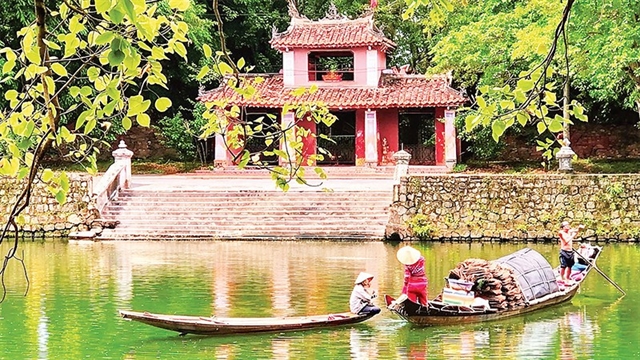
While the Hương (Perfume) River defines Huế as a riverside city, these canals create a quieter, more intimate landscape closely tied to local life.
River tourism along tributaries of the Hương River will diversify tourism services and unlock underused potential of the Huế Imperial Citadel and old quarters. — Photo nhandan.vn
HUẾ — Rivers and canals that once served the Nguyễn Dynasty’s imperial court have now been transformed into unique experiential spaces at the heart of Huế, a heritage city that is popular among domestic and foreign visitors.
Within the urban structure of the Huế Imperial Citadel lies a network of canals -locally known as “man-made rivers” – that encircle and run through the inner city.
The most significant are the Đông Ba and Ngự Hà waterways, artificial canals once used to transport food and goods into the imperial capital. Ngự Hà connects with the citadel’s defensive water system, passing landmarks such as Tịnh Tâm Lake and Tàng Thư Pavilion, while the Đông Ba River – also called the Tả Hộ Thành moat – runs along the eastern ramparts, linking Đông Ba Market with the old quarters of Gia Hội and Chi Lăng before flowing to Bao Vinh, once a bustling trading port.
While the Hương (Perfume) River defines Huế as a riverside city, these canals create a quieter, more intimate landscape closely tied to local life.
According to Cung Trọng Cường, Director of the Huế City Institute for Development Studies, the Đông Ba–Ngự Hà system could offer a distinctive tourism experience, as the canals are well suited to river routes connecting heritage sites, historic neighbourhoods and daily urban life.
Võ Lê Nhật, Secretary of the Party Committee of Phú Xuân Ward, said developing river tourism along tributaries of the Hương River will diversify tourism services and unlock underused potential in the citadel and old quarters, particularly cultural and culinary spaces. However, further investment in landscaping, lighting and visitor facilities is needed
Beyond opening new sightseeing routes, waterways could provide an alternative gateway to the Imperial Citadel, where narrow streets and historic gates limit access for large tour vehicles.
Dương Cẩm Vân, a guide at the Huế Monuments Conservation Centre, said future boat routes would allow visitors to approach the citadel differently – travelling by water after visiting royal tombs and docking directly inside the heritage complex near traditional garden houses or heritage-style restaurants.
Reviving cultural spaces long left dormant
Before the 2000s, the Đông Ba River hosted floating communities, while Ngự Hà fell into neglect due to sedimentation and stagnant water. Restoration efforts began in the late 2010s and have recently accelerated, with dredging, embankment reinforcement and riverside walkways helping reintegrate the canals into urban life.
Reintroducing boats is not only about tourism expansion but also about reviving cultural spaces long “silted up” within the citadel. Tree-lined waterways, old houses behind ancient walls and Huế’s slow-paced lifestyle, together with traditional cuisine, could become key elements of visitor experiences.
River tourism may also reconnect cultural traditions, including classical opera performances staged along water routes.
Nguyễn Mạnh Cường, Vice Chairman of Hóa Châu Ward People’s Committee, said river tours could create new opportunities for Bao Vinh old town, whose residents increasingly see development potential similar to Hội An if managed appropriately.
Small family businesses, such as Mạ Bakery in a riverside heritage house, already attract foreign visitors interested in traditional cake-making. Direct boat access from the city centre could further strengthen experiential tourism.
Under Huế’s inland waterway tourism plan, routes will connect heritage sites, craft villages and historic quarters from the Imperial Citadel to Bao Vinh, Thanh Hà and riverside communities along the Hương River.
Trần Thị Hoài Trâm, Director of the municipal Department of Tourism, said Hue is pursuing a coordinated strategy including clean-energy electric boats, upgraded docks and experience-based routes linked to heritage and the night-time economy to extend visitor stays.
When the first electric boats begin operating along the Ngự Hà–Đông Ba route in this April, canals that once served the imperial capital are expected to become living cultural spaces within Huế’s evolving heritage city. — VNA/VNS
Author: ovietnam.vietnamnews.vn
published 2026-03-17 21:50:45
Source link